Published 09 March 2026 in #an_uncomplicated curator
Mandy Conidaris
BITS OF JOZI
featuring
Colleen Alborough and Allison Klein
accompanied by etchings by David Koloane and Michael Chibogo-Khumalo
@Stokvel Gallery, Melville, Johannesburg, March 2025
curated by Mandy Conidaris #an_uncomplicatedcurator
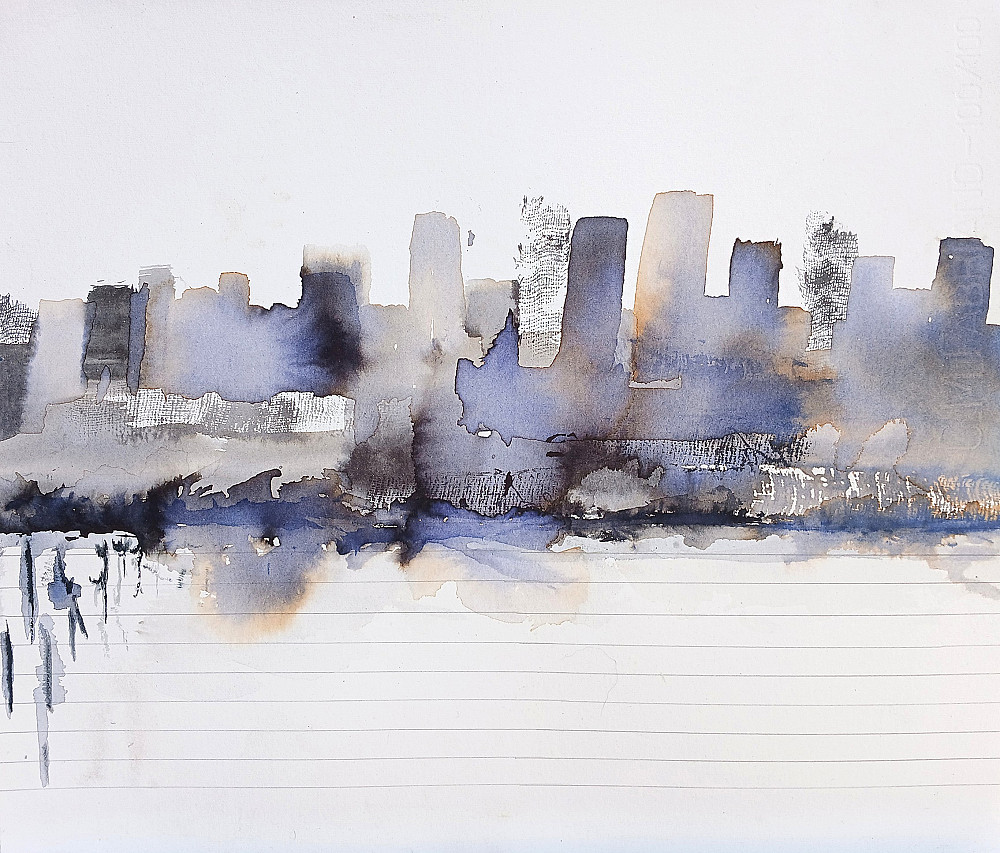
Exhibition cover artwork: Colleen Alborough, Above and below, 2024, Ink drawing
The stimulus for the exhibition BITS OF JOZI is the city of Johannesburg, known locally as Jozi. The artists shown here and I have been deeply affected by living in this city of contrasts.
Jozi has always been about random bits and pieces. This aspect of the city triggered the concept and the title for this exhibition, as well as my choice of Allison Klein and Colleen Alborough as the featured artists. They have both used a variety of elements of collage to create the works exhibited here, although in completely different ways.

Allison Klein, Ophelia in Hillbrow 2, 2025, Giclée print from collage, monotype and linocut

Colleen Alborough, City Birds I, 2015, Collagraph monotype
Interestingly, David Hockney created a series of photo collages in the 1980s. He emphasised that that the fragmented nature of the collage process replicates the human perception of our surroundings better: that “fragmenting a scene into several pieces [achieves] a result that is more similar to how the eye works instead of viewing a single-shot photograph of a scene.”

Allison Klein, Blind spots in Bertrams, 2019, Giclée print from collage and screenprint
And geographically, the original township of Johannesburg, laid out in 1886, was developed from the left-over scrap of grazing land between the registered Boer farms of Doornfontein, Braamfontein, and Turffontein. In its gold-rush beginnings Jozi was inhabited by, well, gold-diggers, and those who serviced them one way or another - individuals from different parts of the country and other continents in search of chance wealth.

Colleen Alborough, Ibis watching, 2024, Ink drawing and collage
As the population evolved and grew, a stable city developed, a collage of folk from many countries and backgrounds who usually continued their own traditions, celebrating their heritages. Even the apartheid regime – which not only repressed the country’s so-called non-white races but also disapproved of and discriminated against other cultures and religions migrating here from Europe’s instabilities and economic depressions – did not manage to quash this multi-ethnic spirit. Which was fortunate for our city, and historian Luli Callinicos (2012) pointed out that ‘Jozi’s greatest asset has always been its rich diversity of human resources’.
But back now to the artwork.
Klein photographed the graffiti on the walls of Yeoville as a starting point for her collages, from which she creates original giclée prints. Her works present both the joyful character of these streets, as may be seen in Blindspots in Bertrams, along with their darkness, as in Still in Bertrams.

Allison Klein, Still in Bertrams, 2019, Giclée print from collage and linocut
Alborough’s collograph prints and mixed media works show both the mechanics of Jozi’s mining history, in part to indicate the level of buried anxiety that living in this city can provoke, and the metaphor of the Hadeda bird – a notorious Jozi scavenger. These two aspects of her symbolism are combined in Remains and Joburg scavenge.

Colleen Alborough, Remains, 2015, Mixed media
Of her own work, Klein states:
“Created in 2019, these works are rooted in the exploration of place, memory, and the layered histories embedded within the Jozi urban landscape. As a Jozi-based artist, I am deeply influenced by the city’s complex social fabric, particularly the visible and invisible scars left by apartheid and its enduring inequalities which still shape daily life. The works reflect my intimate engagement with the Jozi neighbourhoods of Hillbrow, Bertrams, and Yeoville – areas marked by urban decay yet filled with resilience and the vibrant energy of communities navigating their existence.

Allison Klein, Bathsheba, 2025, Giclée print from collage and screenprint
“The starting point for the original series of mixed media prints were photographs I took of some walls, graffiti, and pavements, within a few kilometres of my then-home in Yeoville. I was attempting to capture the textures and contrasts found in these areas through digitally collaging these photographs. I further manipulated the images by overprinting with either linocut or screenprint, to create the effect of a ‘stamp’ to echo the repeating nature of urban transformation and decay. I sought to reconstruct their fragmented narratives by layering the images to suggest the contradictions and overlapping realities of life in these communities.”

Allison Klein, Squatting 3, 2019, Giclée print from collage and linocut

Allison Klein, Squatting 2, 2019, Giclée print from collage and linocut
Alborough explains:
“I am a Jozi-based artist and for over 15 years have been making artwork, mainly mixed media and prints, related to the anxious emotions evoked by living in this city. The works exhibited here are just a fragment of a much larger body of work that began with my creating Balance, a stop-frame animation. Its focus revolved around the complex, disconcerting, and chaotic place that is Jozi.

Colleen Alborough, Tired (from Balance exhibition), 2010, Monotype
“Moving beyond Balance, most of the same materials I used to generate the animation have formed the substance for further works, namely, cotton waste, and cut-out elements from the drypoint and monotype prints. The cotton waste refers to the tangle of disorder in the city’s unseen but ever-present underworld, using here the symbol of the network of mining tunnels that lie underneath us. Since Jozi’s mining beginnings, there has been a sense that it’s been a place to exploit, for people to come in, take what they want, and leave. So, I have used the Hadeda as a symbol for human scavengers, again built up of other waste materials to create the monotype images of these birds.

Colleen Alborough, Joburg scavenge, 2015, Mixed media
“My small, later ink wash landscapes are really ‘minescapes’, again referring to above and below the ground, the layering of Jozi’s foundations.”

Colleen Alborough, Untitled, 2018, Ink drawing
As a curator, I feel privileged to have interspersed the installation of Klein’s and Alborough’s artworks with etchings by David Koloane and Michael Chibogo-Khumalo. These two artists often engage with the bleaker aspect of Jozi life - the inner city and unemployment.

David Koloane, Waiting, 2025, Etching

Michael Chibogo-Khumalo, Moving around, 2005, Etching

Michael Chibogo-Khumalo, There's no jobs, 2005, Etching
Many of us are familiar with the works of the late David Koloane, one of Jozi’s modern masters. Vibrant images of Jozi were his primary subject matter. The etchings on show demonstrate transitory moments of movement through his use of dynamic line work, which animates the images and creates street scenes of a Jozi pulsating with energy. City Traffic I especially reflects the chaos experienced when driving in the city.

David Koloane, City Traffic I, 2012, Etching

David Koloane, Pollution, 2018, Etching
Chibogo-Khumalo's etchings, on the other hand, speak of the isolation and lost identities of the often-migrant workers. Despite his queue of weary commuters crammed close together in What’s happened to the people, as the title suggests they appear to be absent to each other, lost in their own thoughts.

Michael Chibogo-Khumalo, What’s happened to the people, 2005, Etching
The man portrayed in A Place near Joburg seems both individualised and anonymous, present yet nostalgic for another place in time. These sensitive works were created in the 2000’s, and artist himself - like so many others - has vanished from the Jozi artworld.

Michael Chibogo-Khumalo, A Place Near Joburg, 2005, Etching
This exhibition’s small visual fragments of Jozi’s backdrops – historical, physical, psychological, and metaphorical - are but a fraction of what could be revealed about our complex city. Worldwide, the city and urban life have been the focus of much artwork.
Véronique Tadjo (2002) suggests that ‘Art has the power to rejuvenate the city by making her more beautiful, more human, more likeable.’ And Jozi has had its fair share of artists who use our city as source material for their artmaking.

Allison Klein, Blind spots in Yeoville, 2019, Giclée print from collage and screenprint
LIST OF SOURCES IN ORDER OF USE
https://www.contemporaryartissue.com/top-25-collage-artists-in-the-world-a-complete-survey/
Luli Callinicos, 2012. WHO BUILT JOZI: Discovering Memory at Wits Junction. Johannesburg: Wits University press.
Véronique Tadjo, 2002. David Koloane. Johannesburg: David Krut Publishing.
