Published 26 March 2026 in Demystifying fine art prints
Mandy Conidaris
My life with fine art prints
I started making prints in 1991 as one of the first members of Kim Berman’s Artist Proof Studio, then situated in Jeppe Street, Johannesburg. Working initially with linocut and later with etching and drypoint, I decided that printmaking was ‘my medium’! It took many years to realise that one of the reasons that prints resonated so strongly with me was due to my earlier career as a radiographer, where looking at and diagnosing from X-rays and scans has everything to do with identifying shifts in greyscale and pattern recognition.
From 1994, I began working as the Joburg marketing representative for The Caversham Press, a professional printmaking studio in KZN. On my trips to the Press, I fell in love with all aspects of printmaking – the huge variety of images, how different artists worked with each technique, the sight of a pile of beautifully printed images stacked for numbering and signing, even the smell of a freshly opened pack of printing paper.
Part of my work entailed trying to educate art buyers about the value of original fine art prints and how they differed from reproductions of original drawings or paintings .
“What is a fine art print? Where is the original?”
I have been asked this question too many times to count – and have often tried to answer this in a way that makes sense to a non-printmaker. By combining my printmaking knowledge with the awareness drawn from my work as a sonographer who performed 4-D obstetric scans, I feel I have found a good explanation.
The confusion starts here:
Printmaking is the only fine art medium that can create identical multiples of a single image.
“But how?” you ask …
The physical work of the artist takes place on a flat ‘print matrix’ – whether etching or scratching a metal plate, cutting into a slice of wood or linoleum (lino), drawing onto a lithography stone with a waxy crayon, or creating a positive on acetate to expose onto the photosensitive mesh of a silkscreen (*see note below). Whichever surface the artist works on is known as the matrix.
The common feature for all these processes is that the matrix becomes the holder of the ink that will cause an impression – what we call a print - on a sheet of paper. Because the image on the matrix is stable, many prints may be pulled from that matrix. With a fine art print, the number of prints pulled is limited and must also be documented. This number of prints is known as an edition of prints.
“So, what is the ‘real’ work of art?”
Interestingly, the word ‘matrix’ relates to the Latin term for ‘womb’. This offers a wonderful way to explain about fine art prints.
Just as a woman’s womb can gestate an embryo into a child, so the artist can build up an image onto the print matrix. In printmaking terms, this process of image development is known as ‘plate origination’. And as the womb under pressure can propel a child into the world, so the inked print matrix under pressure can push an image onto paper. And equally, as the womb remains hidden, so the print matrix should remain hidden. It is the child who must engage with the outer world as an individual just as those fine art prints must engage with the artworld as original works of art.
And finally, just as a womb can only produce a finite number of children, so the number of identical fine art prints pulled from that matrix is limited.
“And what happens to the matrix once the full edition has been printed up?”
Currently, one of two things.
Traditionally, once the edition had been printed, the matrix was destroyed. This ensured that no further prints could be pulled.
Within the spirit of contemporary experimental printmaking, although no further identical images may be pulled, many artists keep their matrices to use inked sections in different ways for other artworks, such as a collage element for a drawing or painting. This in no way impacts on the value of the identical prints in the edition, but rather adds to the artist’s visual vocabulary, making their work more recognisable.
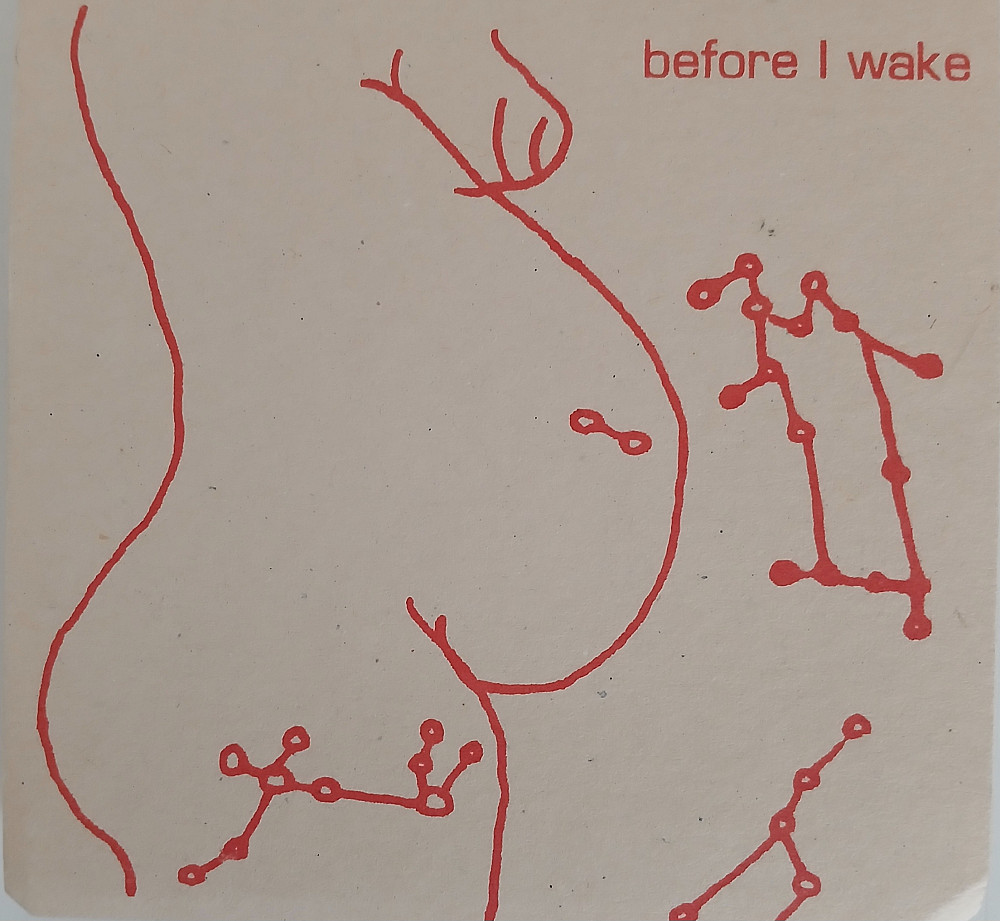
I hope that this explanation gives you a deeper understanding of fine art prints, and that you’ll enjoy the images of gestation from this beautiful screenprinted series before I wake by American artist Jill Larson. The prints were bound into a simple concertina fine art book. It was both printed and bound as an edition of 30 at The Caversham Press, KZN, South Africa in 2001.
 Front cover


 Back cover
*Note: In the case of silkscreen printing (or screenprinting as I prefer to call it), the acetate positive is still once removed from creating the matrix. Through a process of exposing the acetate positive onto a photosensitive silkscreen mesh, a stencil is created on the mesh. The mesh then becomes the matrix, where during printing, the ink passes through the open mesh areas while being blocked by the stencilled areas. This is how the images were created in Jill Larson's series.
Source for the Latin term of matrix as womb:
https://en.wikipedia.org/wiki/Matrix_(printing)