Published 26 April 2026 in South African Printmaking History
Mandy Conidaris
THE SPIRIT OF OUR STORIES
Two years of work from The Caversham Press reflecting a time and place in South African printmaking history.
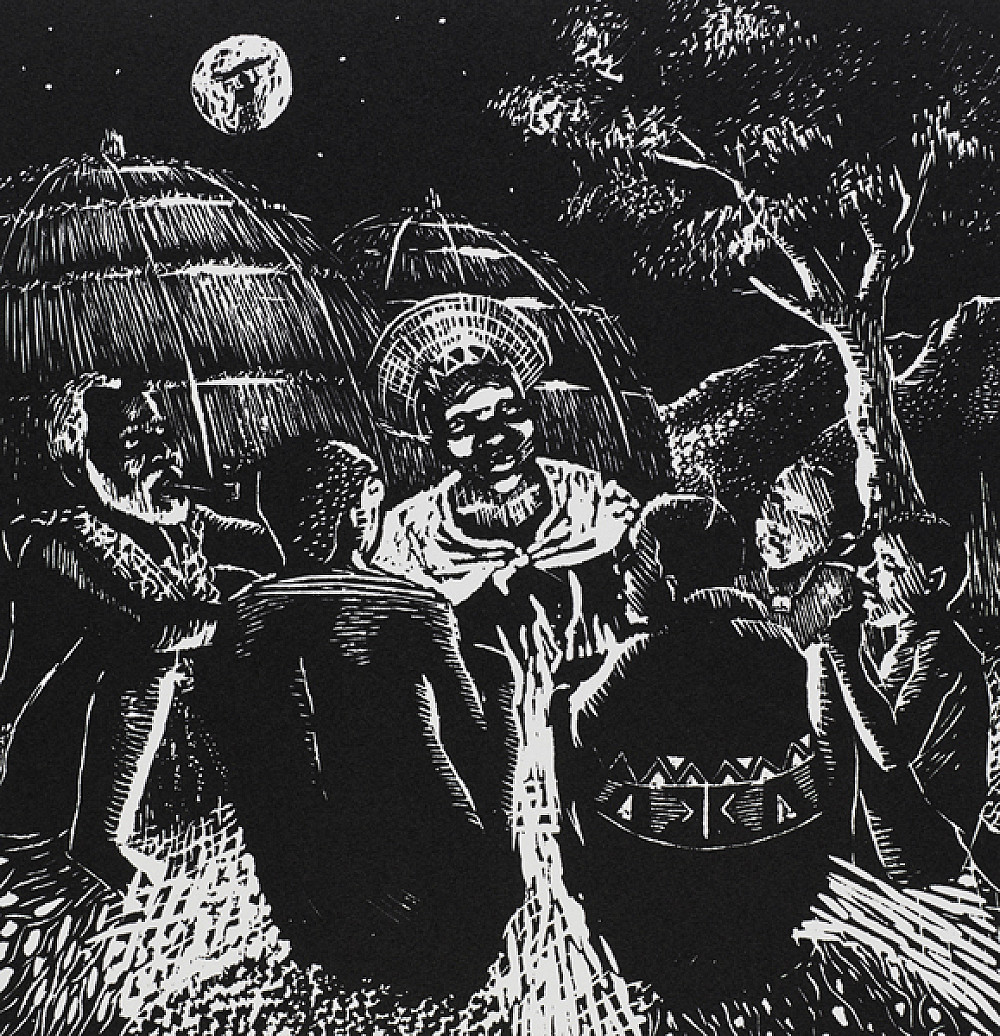
Cover artwork: Sthembiso Sibisi, The Story Teller, 1994, Linocut
The time
1995 was the year following our first democratic election, and the country was filled with optimism for a bright future. Sue Williamson said that “with regard to the new feelings of lightness, one must note the unifying effect that the charm and high moral character of Nelson Mandela have spread across the land” (1996:7). And Archbishop Desmond Tutu named South Africa the ‘Rainbow Nation’ to embrace the idea of diversity within unity, the promotion of tolerance, and a desire to understand the diversity of cultures in the land.
Heady times.
The place: The Caversham Press
For over 30 years, I’ve had a close association with The Caversham Press, one of the first independent professional printmaking studios in South Africa, owned and run by master printmaker Malcolm Christian. Situated in the peaceful, rural KZN Midlands, it opened its doors in 1985 and proceeded to produce some of our country’s most significant and beautiful fine art prints.

Thali Jami, View from The Caversham Press, 1994, Screenprint
How Caversham evolved 1986 - 1993
In its early years, Caversham served as a contract printing studio, working with artists such as Marion Arnold, Deborah Bell, Robert Hodgins, William Kentridge, and Andrew Verster. From 1991, it began to function as a co-operative publishing studio.
An event important to this blog post, was that in 1993, Malcolm formed The Caversham Press Educational Trust. Prior to forming the Trust, he had held a series of informal workshops at Caversham with artists in training in community arts programs. His idea was that such artists should be given the opportunities both of access to printmaking training and facilities, and to work alongside more established artists.

Sthembiso Sibisi, Precious Gift, 1995, Screenprint and lithograph
The Spirit of our Stories project
After forming the Trust, Malcolm realised that work evolved in an easier way once the artists were given a broad theme within which to create. Since he had long had an interest in text and image, he decided to tap into South Africa’s strong oral tradition of storytelling to provide a trigger to generate images. He successfully put forward a proposal to the 1995 National Arts Festival committee to exhibit the printworks of the artists working under the umbrella of the Educational Trust as well as the established artists brought in to participate, and so The Spirit of our Stories project came into being.
The African narrative used came from stories generously provided by the well-known traditional storyteller Gcina Mhlophe*, and then some artists brought their own stories with them.
The participants included some of the country’s most recognised artists, as well as artists from the African Arts Centre in Durban, the Dakawa Arts Centre in Grahamstown (now Makhanda), and ceramic painters from the nearby Ardmore Ceramic Studio. The Ardmore painters worked with imagery similar to that which they were using on the ceramic pieces.

Wonderboy Nxumalo, Making Fire Without Matches, 1995, Screenprint
In total, 24 artists visited Caversham, producing 56 works.
The Spirit of our Stories was exhibited at the 1995 Standard Bank National Arts Festival. It was received positively as the images and tales provided creative insights into the traditions and lives of different cultures, unlike the harsh, overt political overtones of the 1980s resistance arts.
According to Marion Arnold** (2011:13), "The Spirit of our Stories was a recognition that storytelling is not only a powerful means of communication, but is at the root of understanding and articulating personal and cultural identity."

Marion Arnold, Irma in a Mask, Remembering, 1995, Screenprint
Enjoy this small representation of Spirit of our Stories via this wonderful diversity of images:

Vusi Zwane, Out on a Limb, 1995, Screenprint and lithograph

Roxandra Dardegan, Nongqawuse and the Great Xhosa Cattle Killing, 1994, Screenprint

Noluthando Beyi, Qamatha, 1994, Screenprint and lithograph

Noluthando Beyi, Igqurakazi (Witchdoctor), 1994, Linocut

Mmakgabo Helen Sebidi, Lebelo, Le a jelwa, 1995, Screenprint

William Kentridge, The Head and the Load … , 1995, Etching

Shakes Buthelezi, Transportless, 1994, Screenprint

Edith Bukani, The Bakhetwas, 1994, Screenprint and lithograph.

Vuminkosi Zulu, Monkey and the Crocodile, 1995, Linocut

Mavis Shabalala, Men with Elephant and Lion, 1995, Screenprint

Bonnie Ntshalintshali, Daniel and the Lion, 1995, Screenprint
*"Work for The Spirit of our Stories was stimulated by Gcina Mhlophe of Zanendaba, the Storytelling Association, and Educational Trust artists interpreted some of this charismatic storyteller's tales." (Marion Arnold, 2011:13).
** As well as frequently working as a professional artist at The Caversham Press, Marion Arnold is a long-time friend of Malcolm and Ros Christian. A participant in this project, she is an artist, academic, and art historian who has spent many years writing about aspects of the creative output of The Caversham Press.
NOTE: Sadly, The Caversham Press finally closed its doors a few years ago, when Malcolm and Ros retired.
LIST OF SOURCES
Most of the information was drawn from my own research, including many conversations with Malcolm Christian, except for the following:
Arnold Marion, 2011. Sawubona Caversham: Home of People and Prints. Essay from the catalogue South Africa: Artists, Prints, Community: 25 years at The Caversham Press, an exhibition held at the Boston University Art Gallery in 2011.
Sue Williamson and Ashraf Jamal, 1996. Art in South Africa: the future present. David Phillip Publishers: Cape Town.
