August 24, 2007 - September 20, 2007
Gordart Gallery, Johannesburg
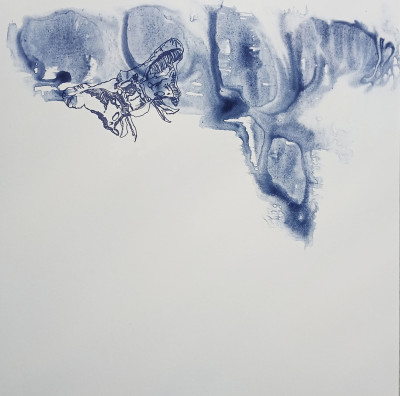
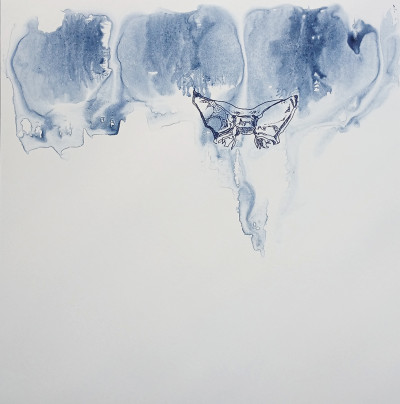
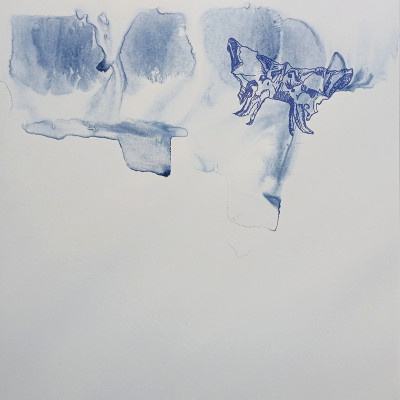
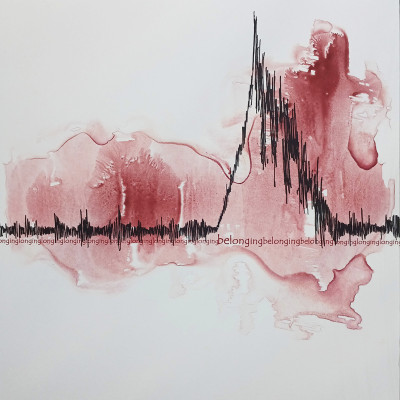
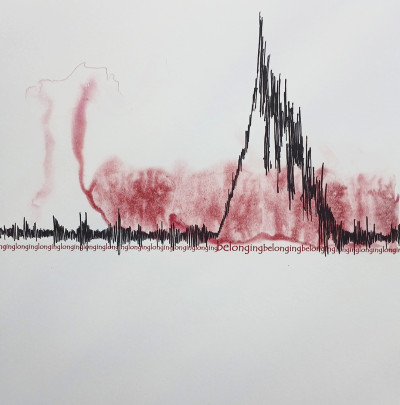
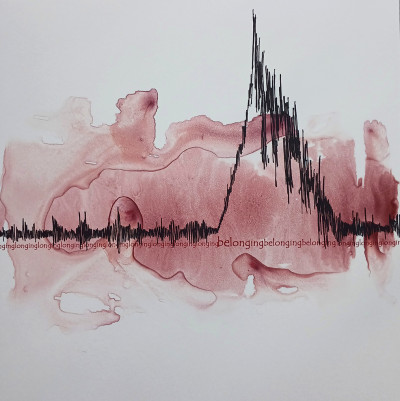
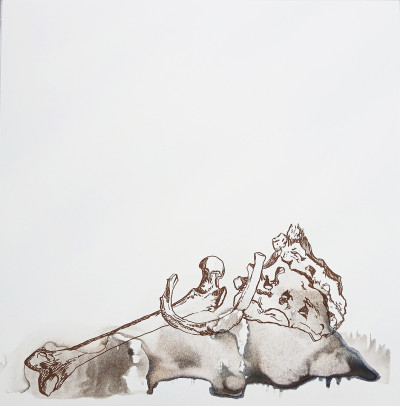
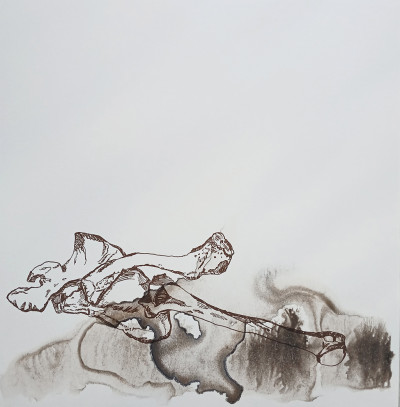
Three friezes of watercolour monotypes over-printed by screenprint
Printed by the artist in her own studio
Borderlands edition of 60
Transmission I, II and III, edition each of 20
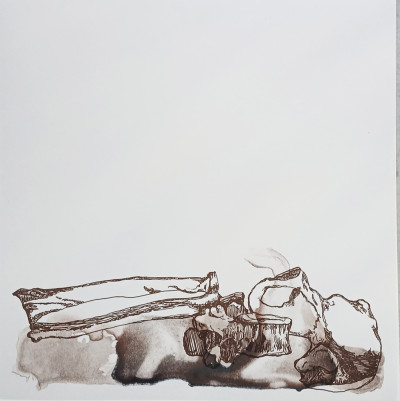
Humus I, II and III, edition each of 20
Borderlands
My contribution to a duo exhibition titled Liminal states with Sheila Flynn
Our hunger to belong is the longing to bridge the gulf that exists between isolation and intimacy.
John O’Donohue, 1998.
Artist's statement
This print installation, exhibited in 2007 at the original Gordart Gallery, ran around four walls of a small room in the gallery.
The installation consisted of three friezes of 60 prints each. The underlying concept refers to our physical and spiritual existence. The two combined printmaking techniques used – unique watercolour monotypes and identical screenprints - are intended to reflect both our individuality and our biological similarities.
The middle frieze, Borderlands, was created first and shows the flatline and peak of a pulse, suggesting two opposite poles of human experience - longing and belonging. In each print, the red text indicates the red baseline seen on a medical graph and reads 'longing' below the flatline and 'belonging' below the peak of the pulse. Here, the frieze refers to our heartbeat.
The upper frieze, Transmission, relates to our intangible spirituality, represented here by the sphenoid bone within our skull that transmits essential blood vessels and nerves. Visually, its bony structure speaks of the ephemerality of a moth, fluttering towards the light.
The lower frieze, Humus, depicts loose bones, conveying how our bodies root us to a time and place, pulling us back and down to our ultimate decomposition.
The friezes relate to three significant aspects of our existence: the transitory nature of our spirits’ imaginings; the inevitability of our shifting emotions of longing and belonging; and the bones of our physical beings.
A NOTE:
The visual metaphor for the Borderlands frieze was inspired by my part-time work at that time, as a radiographer and sonographer. The most basic principle of medical Doppler sonography – the imaging of blood vessels - involves viewing the resistance and flow of blood. Sound waves are transmitted through the skin via a sonar (ultrasound) probe, and echoes of different strengths from the blood vessels bounce back to the probe to be translated into a graph for diagnostic interpretation. The images of the bones for the Transmission and Humus friezes were sourced from the classic medical text book Gray's Anatomy, which has beautiful Victorian era medical diagrams.
Acknowledgements
The following sources were used to research my topic
Leonard, C H. 1983. The Concise Gray's Anatomy. (16th edition, first edition 1889). Omega Books: Hertfordshire.
O’Donohue, J. 1998. Eternal Echoes: exploring our hunger to belong. Bantam Press: London
Sanders, R.C. 1998. Clinical Sonography. Lippincott, Williams & Wilkins: Philadelphia.